

Ask a higher ed professional to share an example of a rubric, policy, accessibility checklist (or anything that you may need) and it’s in your inbox within the hour. Tell them you’ve started a company and watch what happens to the conversation.
The fastest way to become a stranger to your own professional community is to start charging for what you used to give away. And if you’ve tried to build something, you already know where that line sits — you crossed it.
People who work in higher education are, in the ordinary course of things, extraordinarily generous. Even when your own institution is siloed and your own office is a bunker, there is a network of people all over the world willing to answer a question and share what they’ve built. The authors of Going Alt-Ac put it simply: education attracts altruistic people (Kelly et al., 2020).
So when I left my full-time higher ed job in 2019 to start an independent center for teaching and learning, I assumed collaboration would be the easy part. It had to be — I was building something that required more expertise than I had on my own.
In the fall of 2019, I reached out to higher education professionals who had built (or were beginning to build) their own consulting practices, businesses, and entrepreneurial ventures. Some were well established. Others were just finding their footing but already active on social media and in professional communities. I proposed collaborations, cross-promotion, and other ways we might work together.
The response was lukewarm. Some expressed interest, but many seemed wary and fiercely protective of their niche.
The listservs told a similar story from a different angle. When I announced the company on POD and EDUCAUSE, described a basic set of services, and invited collaborations, there were quite a few responses but most were looking for something else. They wanted opportunities and project placements. Very few were interested in partnering.
And sometimes what came back was sharper than indifference. There is a particular moment anyone who has tried this will recognize — the point where a conversation changes temperature. A thread you’ve contributed to for years reads differently once your signature line includes a company name. A warm exchange turns careful. The same resource that would have been welcomed from a colleague gets flagged as advertising when it comes from a founder. Many professional communities have explicit rules about it: no promotion, no vendors, no solicitation. The unwritten version is broader, and it is simply that we do not trust people who are here to sell.
I want to be fair about that wariness, because it isn’t irrational. Higher education professionals are marketed to relentlessly – by platforms, publishers, and consultancies with budgets none of us have, promising transformation and delivering a login. A community that protects itself from that is doing something sensible. The problem is that the filter is crude. It catches the former colleague who left an institution and is now trying to do the same work from the outside, with the same expertise, for institutions that still need it.
And if you’re honest, you have probably been on the other side of the filter. Someone in your space emailed about working together, you noticed the company in the signature, and you didn’t reply.
The Training Underneath the Filter
Here is the part we don’t say out loud: the community’s suspicion isn’t the only thing pushing us toward the door. We carry our own version of it with us from academia.
Thomas Tobin once described it to me plainly. As graduate students, he said, we were taught to be lone, individual scholars whose work should serve the field. Building knowledge was honorable. Sharing knowledge was expected. But selling that work—or being openly entrepreneurial about it—was often treated as somehow “dirty,” not the right way to be.
That training doesn’t disappear the day you file the paperwork for an LLC.
It follows you into every conversation.
So when the room cools, part of you nods along. When someone doesn’t respond to your invitation to collaborate, part of you wonders whether you crossed an invisible line. When you hesitate before mentioning your business on a listserv you’ve belonged to for years, that hesitation isn’t only about community norms. It’s about identity.
Somewhere along the way, many of us learned to equate generosity with giving our expertise away and professionalism with distancing ourselves from commerce. We became comfortable being colleagues, mentors, committee members, and scholars. We became far less comfortable being founders.
The result is a strange contradiction.
We encourage innovation inside our institutions while quietly distrusting it outside them. We celebrate faculty who secure multimillion-dollar research grants but become uneasy when a colleague builds a consulting practice. We praise partnerships between universities and industry while viewing individual entrepreneurship with suspicion. The boundary between serving higher education and building a business around that service becomes blurred, even though the underlying expertise—and often the mission—hasn’t changed at all.
That is the quiet, respectable form of going it alone.
It doesn’t announce itself as fear or scarcity. It presents itself as humility. As service. As academic integrity.
The community’s filter closes the door from the outside.
Our academic legacy quietly convinces us not to knock.
The Self-Made Founder Is a Fiction
The myth is that this solitary path is either necessary or admirable.
It is neither.
No one builds anything of consequence alone. The claim of self-made success mostly reveals how little actually got made; one is simply too small a number to build something that lasts.
And this isn’t sentiment. Research consistently shows that entrepreneurs who cultivate strong networks and social capital are more likely to advance through the startup process and improve their venture’s chances of survival (Davidsson & Honig, 2003; Bandera & Thomas, 2019; Song et al., 2021). Going it alone isn’t the noble version of edupreneurship. It’s the fragile one.
Which means the isolation so many edupreneurs describe isn’t a badge, and it isn’t a life sentence.
It’s a design problem.
And design problems have solutions.
Research consistently shows that entrepreneurs who cultivate strong networks and social capital are more likely to advance through the startup process and improve their venture’s chances of survival (Davidsson & Honig, 2003; Bandera & Thomas, 2019; Song et al., 2021).
Building a Village on Purpose
The answer is not to win the room back by proving you’re not really one of those people who sells. It’s to stop waiting for permission and build your village deliberately.
That village takes many forms: collaborators, mentors, strategic partners, peers, the occasional freelancer, and the friends and family who quietly hold everything together. Some relationships run on reciprocity. Others are built on generosity without keeping score. Adam Grant argues that genuine givers often outperform takers over time, while cautioning against the “doormat effect”—giving so much that nothing is left for the work that sustains you (Grant, 2013). The goal isn’t to give until you’re empty. It’s to build relationships strong enough to carry meaningful work.
For me, that meant redefining collaboration. I stopped looking for people who did exactly what I did and started looking for people who did what I couldn’t.
The strongest ventures aren’t built by becoming everything. They’re built by bringing together people with genuinely different strengths.
Ironically, that’s what higher education has always done well. Colleges and universities don’t succeed because every individual possesses every skill. They succeed because they assemble communities of expertise around a common purpose.
Many of us leave those institutions only to try becoming every department ourselves.
Perhaps the challenge isn’t learning how to be entrepreneurs.
Perhaps it’s learning how to recreate, intentionally and at a human scale, the collaborative ecosystems we’ve spent our careers working within.
Higher education is changing. More professionals will build consulting practices, nonprofits, coaching businesses, research firms, educational technology companies, and organizations we haven’t yet imagined. They’re not leaving the profession—they’re expanding it.
If Going Alt-Ac is right that education attracts people who genuinely want to serve others, then perhaps the next evolution of that service is learning to build together outside institutional walls as well as within them.
That’s the community I hope we create.
A village where higher education professionals share opportunities as readily as they share rubrics. Where collaboration extends beyond committees and campuses. Where someone else’s success is seen not as competition, but as evidence that the ecosystem is growing.
Because institutions may no longer be responsible for creating that community.
But we are.
And perhaps that’s the real work of the next chapter—not simply building businesses, but building one another.
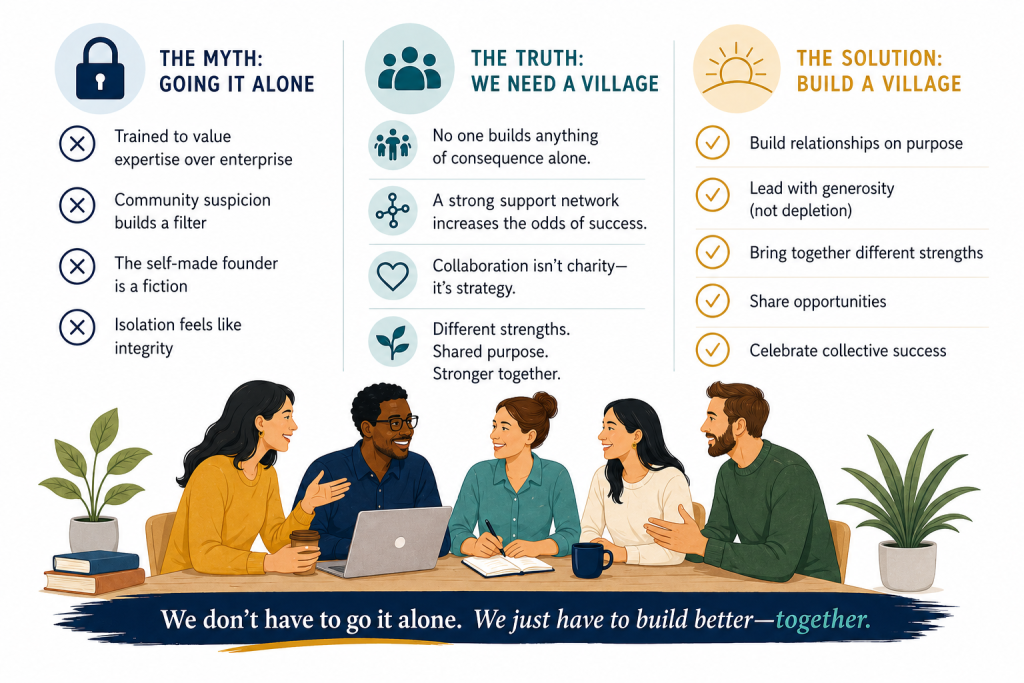
Whatever your next chapter looks like, you don't have to figure it out alone.
References
Bandera, C., & Thomas, E. (2019). The role of innovation ecosystems and social capital in startup survival. IEEE Transactions on Engineering Management, 66(4), 542–551.
Davidsson, P., & Honig, B. (2003). The role of social and human capital among nascent entrepreneurs. Journal of Business Venturing, 18(3), 301–331.
Grant, A. (2013). Give and take: A revolutionary approach to success. Viking.
Kelly, K., Linder, K. E., & Tobin, T. J. (2020). Going alt-ac: A guide to alternative academic careers. Stylus Publishing.
Song, Y., Dana, L. P., & Berger, R. (2021). The entrepreneurial process and online social networks: Forecasting survival rate. Small Business Economics, 56(3), 1261–1279.