

The provost announces the consolidation on a Tuesday. Three departments become one. A new reporting structure, a new platform, a new set of shared services. By Friday you’ve been asked to bring it to your unit on Monday — to explain it, to answer questions, to get people on board.
And you haven’t accepted it yourself.
This is the position so many people in higher ed are actually occupying: you are simultaneously the change agent and the target. You’re expected to manage other people’s resistance while privately managing your own — and possibly while updating your CV in a browser tab you close when someone walks by. Middle positions absorb the most disruption in any change, and they’re the ones asked to lead through it anyway.
So this post comes in two halves, because the work is genuinely different in each direction.
In higher education, many managers, department chairs, directors, and faculty leaders occupy both roles at once. They are expected to lead institutional change while quietly navigating that same change themselves. That tension is where resistance becomes personal.
Resistance is not a character flaw
First, something that applies both ways. Resistance isn’t dysfunction, and the colleague pushing back isn’t difficult, negative, or stuck in 1998.
The Accelerating Implementation Methodology puts it usefully: resistance is a simple attempt to protect one’s personal frame of reference (Implementation Management Associates, n.d.-b). It isn’t irrational. It’s protective. And it isn’t proportional to how good the plan is — it’s proportional to how much disruption the change represents from that person’s point of view, which means you cannot argue, explain, or town-hall your way out of it (Implementation Management Associates, n.d.-a).
That’s what most institutional change gets wrong. When faculty push back, the standard response is another email, another forum, another deck explaining the rationale. If resistance were an information problem, that would work. It isn’t, so it doesn’t.
Frame of reference: the same change, four different changes
A frame of reference (FOR) is the lens each person brings — their history, their incentives, what they’ve been promised before, what they stand to lose. Change lands on the frame, not on the org chart. Conner (2006) put it plainly: some people see a change as an obvious extension of where things were already headed, and others experience the identical announcement as coming out of left field.
Picture that consolidation hitting four people in the same unit:
- The tenured full professor sees a threat to curricular autonomy she spent twenty years earning.
- The adjunct sees a possible route to a real line — or the elimination of his courses.
- The instructional designer sees her third platform migration in six years and does the math on what that costs her.
- The administrative coordinator, who holds every undocumented process in her head, sees a system that makes her invisible.
Same announcement. Four different changes. Brief all four the same way on Monday and you’ll be surprised by three of them.
The practical move is to stop asking how do I get buy-in and start asking, for each group: what are they being asked to give up, what have they been promised before, and what does success cost them? AIM formalizes this as a set of questions for anticipating resistance before it surfaces (Implementation Management Associates, n.d.-a). A rough version on a legal pad takes twenty minutes and will be the most useful twenty minutes you spend.
Motivation: the case nobody made
Institutional announcements almost always state what is changing. They frequently state why, in the language of the people who decided it — efficiency, alignment, sustainability. They rarely state the consequences of standing still in terms anyone recognizes, and they almost never answer the question every person in the room is actually asking, which is some version of what happens to me.
A complete case for action names what success looks like, why it matters, and what happens if nothing changes — inside each affected group’s frame of reference (Implementation Management Associates, n.d.-c). Where the definition is vague, the gap fills with resistance. People construct their own explanation, and the version they invent is almost always worse than the truth.
There’s a harder question underneath. Do you need people to do this change, or to believe in it? Compliance and commitment are different targets requiring different strategies (Implementation Management Associates, n.d.-c). A mandated accessibility standard needs compliance, and it’s honest to say so. A shift in teaching culture needs commitment, and pretending a directive will produce it wastes a year.
Much of the cynicism I hear from higher ed professionals comes from watching leaders ask for commitment while behaving as though they wanted compliance.
What resistance looks like from the outside
It’s rarely the person who says no in the meeting. That one is a gift — overt resistance is visible and can be worked with.
Covert resistance is the problem, because it disguises itself. The most common costume is can’t worn over won’t: the workload objection, the technical concern, the sudden discovery of a policy barrier. Silence is data too, and enthusiastic agreement followed by nothing is one of the most reliable signals there is (Implementation Management Associates, n.d.-a).
The instinct is to treat the surface objection as the real one and solve it. You resolve the scheduling conflict; a new obstacle appears. Two or three rounds of that teaches you what to ask first: not what’s the problem with this but what would make this genuinely bad for you.
And then stop over-investing in communication. What leaders reinforce — what gets rewarded, resourced, and evaluated — carries far more weight than what they announce (Implementation Management Associates, n.d.-d). If the old behavior still gets rewarded, everyone correctly concludes the change is optional.
Two Curves of Personal Transition
There are two change curves, they describe two different personal trajectories, and neither is a tool for reading the room. Both are for locating yourself.
Which one you’re on has nothing to do with whether you chose the change. It depends on how you initially perceived it (Conner, 2006). You can dread something you chose. You can quietly welcome a reorganization everyone around you is mourning.
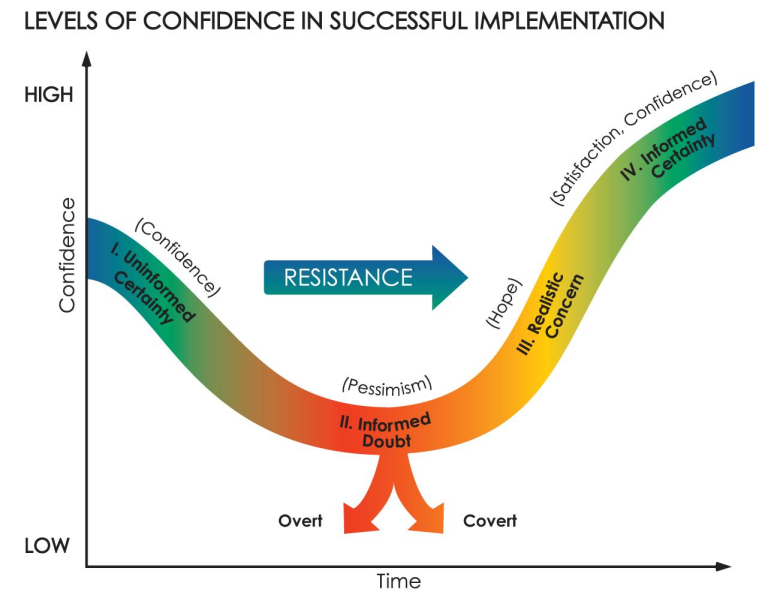
If your first read was positive, you’re on a curve that tracks confidence, and its shape is counterintuitive: it starts high and drops.
You begin at uninformed certainty — genuine confidence, built on not yet knowing much. Then reality arrives and you fall into informed doubt, the trough, where you now understand what this will actually cost and your confidence bottoms out. This is where your own resistance shows up, in the same overt and covert forms you’d recognize in a colleague. From there, if you keep going: realistic concern, which is hope with its eyes open, and finally informed certainty — confidence again, but earned this time.
The critical thing about informed doubt is that it feels like evidence you were wrong. It usually isn’t. It’s what month eight feels like — for the person who left to consult, for the one who finally took the leadership role, for the one who fought for the new program and got it. The trough is structural, and Conner’s observation is that it’s exactly where people check out.
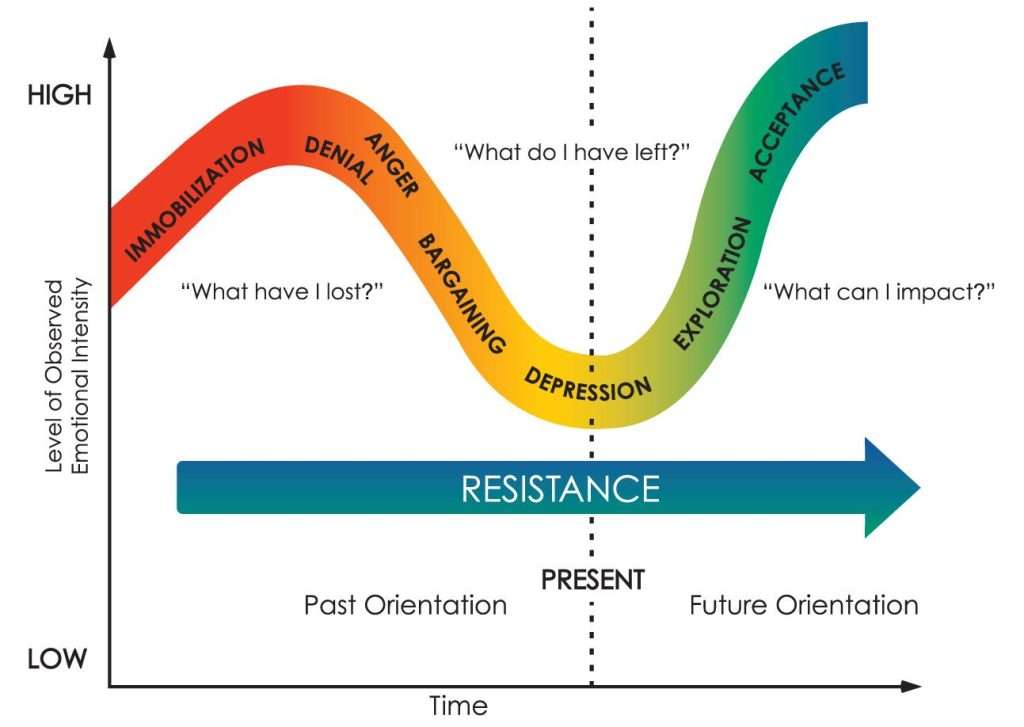
If your first read was negative, you’re on a different curve – one that tracks emotional intensity rather than confidence, running from immobilization through denial, anger, bargaining, and depression, then into exploration and eventually acceptance.
The stage names matter less than the direction you’re facing. Early on, the questions are backward-looking: what have I lost, what do I have left. Near the bottom, the orientation turns, and the question becomes what can I actually affect? That pivot from past to future is the real marker of movement – not feeling better, but facing a different way.
Two practical uses. First, locate yourself honestly and name the stage. Second (and this is the harder one) – surface your own resistance early and constructively, rather than waiting for it to leak out sideways in a meeting. Deciding in advance how you’ll voice your doubts is different from suppressing them, and it’s the difference between being a colleague with reservations and being the person everyone works around.
One note for the position you’re in. You started your curve on Tuesday. Your colleagues start theirs Monday. You aren’t ahead of them because you’re more adaptable but because you are on separate clocks, five days apart. Give them the head start you got.
What’s actually being lost
Underneath resistance – yours and theirs, is a loss the person often can’t name. Naming it precisely is most of the work, and “change fatigue” is too blunt an instrument.
Ask what specifically is going, in these terms: future (a plan that no longer exists), identity (who you were in this role), relationships (a team dispersing), security, trust, affiliation (belonging to something), personal leverage (the informal influence you’d accumulated), and control.
Run that list against yourself and the result is often uncomfortable. With higher ed professionals, the two that surface most are identity and personal leverage: not the salary, not the workload, but I no longer know who I am here and I used to be able to get things done and now I can’t.
Five ways we respond
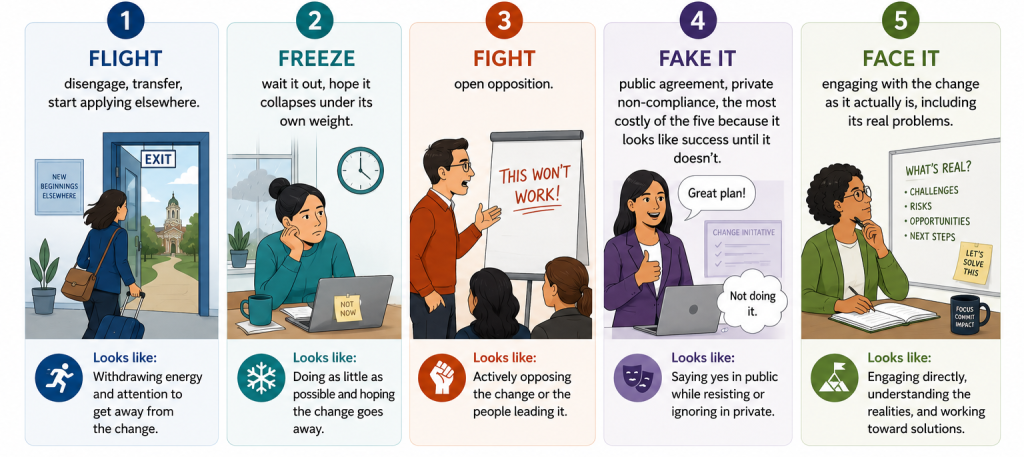
Responses to change fall into recognizable patterns, and it’s worth knowing your default.
- Flight — disengage, transfer, start applying elsewhere.
- Freeze — wait it out, hope it collapses under its own weight.
- Fight — open opposition.
- Fake it — public agreement, private non-compliance, the most costly of the five because it looks like success until it doesn’t.
- And face up to it — engaging with the change as it actually is, including its real problems.
None is a character verdict. But run one more diagnostic, because your history is a variable: think about the last significant change at your institution and how you responded. If that change didn’t work — if the platform was abandoned, the reorg reversed, the initiative quietly defunded — that experience is in the room with you now and will shape this one whether or not you acknowledge it. Institutional memory is long in higher ed. When people say “we’ve seen this before,” they usually have.
Change is external. Transition is internal.
The last distinction, and the one I’d most want you to keep.
William Bridges separated the two: change is situational — the reorganization, the platform, the new title. Transition is the psychological process of coming to terms with it, moving through an ending, a disorienting middle, and eventually a new beginning (Bridges, 1980). Change gets announced on a Tuesday. Transition takes as long as it takes.
Which means the reason Monday is hard isn’t the consolidation. It’s being asked to lead thirty people into a new beginning while standing in your own ending — grieving a version of your work that isn’t coming back, without yet knowing what replaces it.
The neutral zone is the most misread stage of all. It’s disorienting and unproductive and makes competent people feel like frauds, and in higher ed I constantly see it mistaken for a verdict: I feel this bad, therefore I should leave. Sometimes leaving is right. But the neutral zone feels identical whether you’re on your way out or on your way through, and decisions made from inside it are notoriously unreliable. The discomfort isn’t the signal. It’s the terrain.
Strategies
For the change you’re carrying:
- Map frames of reference before you communicate anything. Four groups, three questions each.
- Build the case backward — start with the consequences of standing still, in their terms.
- Decide honestly whether you need compliance or commitment, and stop asking for the one you aren’t structured to earn.
- Treat every objection as a symptom until proven otherwise. Ask what would make this genuinely bad for them, then run the loss inventory.
- Put your effort into reinforcement, not announcements.
- Work the informal network. The people who move opinion in your unit are rarely on the org chart, and you know who they are.
- Remember they’re five days behind you, not five years.
For the change happening to you:
- Locate yourself on the right curve. Ask first how you actually perceived this change when you heard it — not whether you chose it.
- If your confidence has collapsed, name it as informed doubt rather than as proof you were wrong.
- Notice which direction your questions face. What have I lost is a normal place to be. Movement starts when you can genuinely ask what can I affect.
- Decide in advance how you’ll surface your own resistance constructively — to whom, in what forum, in what words.
- Run the loss inventory on yourself: future, identity, relationship, security, trust, affiliation, leverage, control.
- Name your default response — flight, freeze, fight, fake it, face up — and account for what the last change did to you.
- Separate the change from the transition. The reorg is done and not yours to control. The transition is yours entirely, on a different clock.
- Mark the ending out loud, at least to yourself. Skipping it doesn’t accelerate anything; it relocates the grief.
- Don’t make irreversible decisions from the neutral zone. Make small reversible ones instead.
- Find people outside your institution to think with. Your colleagues share your frame of reference — they can commiserate, but they can’t give you perspective.
Most of the resistance isn’t obstruction. It’s people protecting something real without language for what it is. That’s true of your faculty on Monday morning, and it’s true of you on Friday afternoon. The work is the same in both directions: find out what’s being lost, name it accurately, and stop treating a human response as a problem to be overcome.
References
- Bridges, W. (1980). Transitions: Making sense of life’s changes. Addison-Wesley.
- Conner, D. R. (2006). Managing at the speed of change: How resilient managers succeed and prosper where others fail. Random House.
- Implementation Management Associates. (n.d.-a). Change management methodology: Resistance can be overt or covert. IMA Worldwide. https://imaworldwide.com/change-management-methodology-resistance-can-be-overt-or-covert/
- Implementation Management Associates. (n.d.-b). Drive change success: Proven management methodology. IMA Worldwide. https://imaworldwide.com/the-aim-methodology/
- Implementation Management Associates. (n.d.-c). The define the change practice area. IMA Worldwide. https://imaworldwide.com/the-define-the-change-practice-area/
- Implementation Management Associates. (n.d.-d). Overcoming employee resistance to change: Consulting framework. IMA Worldwide. https://imaworldwide.com/resistance-to-change/